Wednesday, 8 September 2010

Tuesday, 24 August 2010
Why you should focus on social learning
Thanks to Jane Hart for pointing to this slide deck from Charles Jennings.
Jane's blog Social Media for Working and Learning is well worth subscribing to.
Jane's blog Social Media for Working and Learning is well worth subscribing to.
Tuesday, 10 August 2010
Monday, 9 August 2010
Friday, 16 July 2010
Paper training feedback forms - why?
Surely there is a better way to gather and use feedback from training sessions? I can't help feeling that if feedback is committed to paper then it won't get read by many and will be filed away - probably never to be seen again. This has certainly happened to some of the feedback forms I have had from sessions.
This feedback is invaluable and could be used in such better ways. On a very basic level it could be used in the same way recommendations are used on Amazon. See what others said about this course etc
And for the trainer comments could be used for testimonials, a way of carrying on the conversation with delegates to enhance the training etc.
Clearly confidentiality is key so only delegates who want to make comments public should.
This feedback is invaluable and could be used in such better ways. On a very basic level it could be used in the same way recommendations are used on Amazon. See what others said about this course etc
And for the trainer comments could be used for testimonials, a way of carrying on the conversation with delegates to enhance the training etc.
Clearly confidentiality is key so only delegates who want to make comments public should.
Monday, 5 July 2010
Is this course right for me?
How can you answer this question other than reading the course outline and asking who typically goes on the course and what they typically learn?
The only way to do this is to ask someone who may have been on the course already. Traditionally, this would have been easier said than done. But add a networking tool, such as Yammer, into the mix and you have an opportunity for former delegates to ask prospective delegates whether a course is right for them or not.
This happened recently in my workplace. The discussion enabled a prospective delegate to learn at what level a technical course was pitched. They realised it was not advanced enough for them and so could cancel in time to let someone else attend in their place.
The discussion on Yammer also served other purposes - it helped promote the course and enabled others to see who was right for the course.Obviously, such communication would have saved the company some money - I hope it would have delivered a set of delegates who were right for the course.
The only way to do this is to ask someone who may have been on the course already. Traditionally, this would have been easier said than done. But add a networking tool, such as Yammer, into the mix and you have an opportunity for former delegates to ask prospective delegates whether a course is right for them or not.
This happened recently in my workplace. The discussion enabled a prospective delegate to learn at what level a technical course was pitched. They realised it was not advanced enough for them and so could cancel in time to let someone else attend in their place.
The discussion on Yammer also served other purposes - it helped promote the course and enabled others to see who was right for the course.Obviously, such communication would have saved the company some money - I hope it would have delivered a set of delegates who were right for the course.
Tuesday, 22 June 2010
Interesting social learning discussion
Today Jon Ingham hosted a webinar on social learning. Here is the Twitter back channel - which is well worth a look.
Social learning ramblings
UPDATE: Check out this post about businesses becoming more open.
Just some ramblings . . .
Just some ramblings . . .
- If you are going to provide tools that enable your employees to talk to each other and the wider world then you are going to have to trust them.
- Communication underpins knowledge sharing and collaboration so if you want employees to do this online you will have to accept that you you and your colleagues will be able to see their dialogue.
- Organisations that trust their employees are likely to be more open and have a stronger relationships at manager level (between managers and managers and their teams)
- Social learning cannot succeed in command and control organisations (where control = lack of trust in employees)
- Learning takes place at all levels in a successful organisation - as organisations themselves are constantly learning (or should be).
Friday, 18 June 2010
Following the Enterprise 2.0 conference
I love Twitter for many reasons - one is to be able to follow and events - check out the stream from the E2conference in Boston - great content, conversation and links.
Need a conference like that in the UK.
Need a conference like that in the UK.
Build a learning management system, but will they come?
Good post on the E-learning 24/7 blog looking at how to market a new learning system - I particularly like the rule - Don't call it a learning management system.
What I would add to this post is this: for any system to gain any kind of traction you need to be aware of the barriers to engagement, especially if you previously had an underused LMS.
Factor in the fact that any system is there to enable and facilitate learning so really must have the user at the heart of it. To do this, you need to ensure that you do your homework.
What I would add to this post is this: for any system to gain any kind of traction you need to be aware of the barriers to engagement, especially if you previously had an underused LMS.
Factor in the fact that any system is there to enable and facilitate learning so really must have the user at the heart of it. To do this, you need to ensure that you do your homework.
- Research the potential users - what do they ewant, how would they use such a system and how did previous iterations fail. Segment user types to get as full a picture as you can - this should be ongoing
- Research the stakeholders - what are the business goals for this system, what will success look like and how will this be measured.
- Create user personas - imaginary (but based on reality) profiles of typical user types which look at overview of who that person is job role, tasks etc, look at user goals fro LMS and look at business goals - what that person is trying to achieve in their role. Also provide some general info - hobbies, online activity etc
- Design the system but include users in the process - take users from the research as they are likely to be more enagaged
- Design . . . test . . . build . . . test . . . and keep challenging your assumptions. And ensure you socialise your developments to your users so they get sight of developments and can provide a useful feedback loop.
Thursday, 17 June 2010
Look what social networkers are doing for brands
Interesting report finding showing how comfortable social networkers are with engaging with products and brands online. I highlight this because the report is highlighting wider behavioural shifts here. And it is these shifts that are important for organisations - our employees are doing this online now. So, how are we enabling those very same people to act in similar ways within the corporate firewall?
Wednesday, 16 June 2010
How to ensure an elearning project fails
Great article on Training Zone (need to log in) by Laura Overton, director of Towards Maturity, on how to ensure your elearning project fails. The main tips for what not to do are:
- Take advantage of preconceived ideas (mandate it and make it boring)
- Isolate your learner Keep your focus on your priorities – the technology
- Put elearning design in the hands of the right people
- Don’t engaging stakeholders too soon
- Focus on cutting cost
- Make sure that the solution cannot scale
A social media strategy for learning
Here is a great slide on creating a social media strategy for your business.

Now, think about how you might evolve the slide to create a social media strategy for learning . . . The point here is that the key concepts of social media tools are the same whether you are talking marketing, sales or learning. I'll add my concept when I have done it!
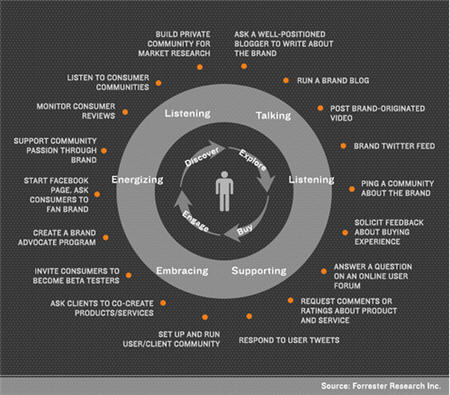
Now, think about how you might evolve the slide to create a social media strategy for learning . . . The point here is that the key concepts of social media tools are the same whether you are talking marketing, sales or learning. I'll add my concept when I have done it!
Thursday, 10 June 2010
Creating positive user experiences
Whatever elearning or social learning tools you are using, make sure you focus on the basics . . .
Wednesday, 9 June 2010
Top 125 elearning posts for 2009
Don't you just love lists? I do, and here is a useful one of the top elearning posts for last year courtesy of elearninglearning. [H/T @richchetwynd]
Monday, 7 June 2010
Friday, 28 May 2010
Subscribe to:
Posts (Atom)
